
Everyone's hyped about coding agents right now. Claude Code, Cursor, Copilot, Codex — every week someone on Twitter posts "I built a full SaaS in 4 hours with zero coding experience" and gets 10k likes.
Cool. Now show me that thing running in production six months later. Show me the error logs. Show me how it handles 500 concurrent users. Show me the security audit.
You can't. Because vibe coding builds demos, not products.
I used Claude Code last week. Spent a solid week building a platform with it. And I'm gonna be honest with you — the reality is way more nuanced than either side wants to admit. It's not magic. It's not garbage either. But it's definitely not what the vibe coders think it is.
Let me break down what the actual data says, and then I'll tell you what I experienced firsthand.
Everyone Uses It, Nobody Trusts It
Stack Overflow's 2025 Developer Survey hit 49,000 plus developers across 177 countries. Here's what came back.
84 percent of devs are using or planning to use AI tools. But only 29 percent actually trust what those tools produce. That's down from 43 percent last year and 55 percent the year before. First time in survey history that devs who actively distrust AI output (46 percent) outnumber the ones who trust it (33 percent).
Only 3 percent said they "highly trust" AI-generated code. Among experienced developers that drops to 2.6 percent.
So we've got this weird situation where almost everyone is using tools they don't trust. Why? Because the speed is real. The accuracy isn't.
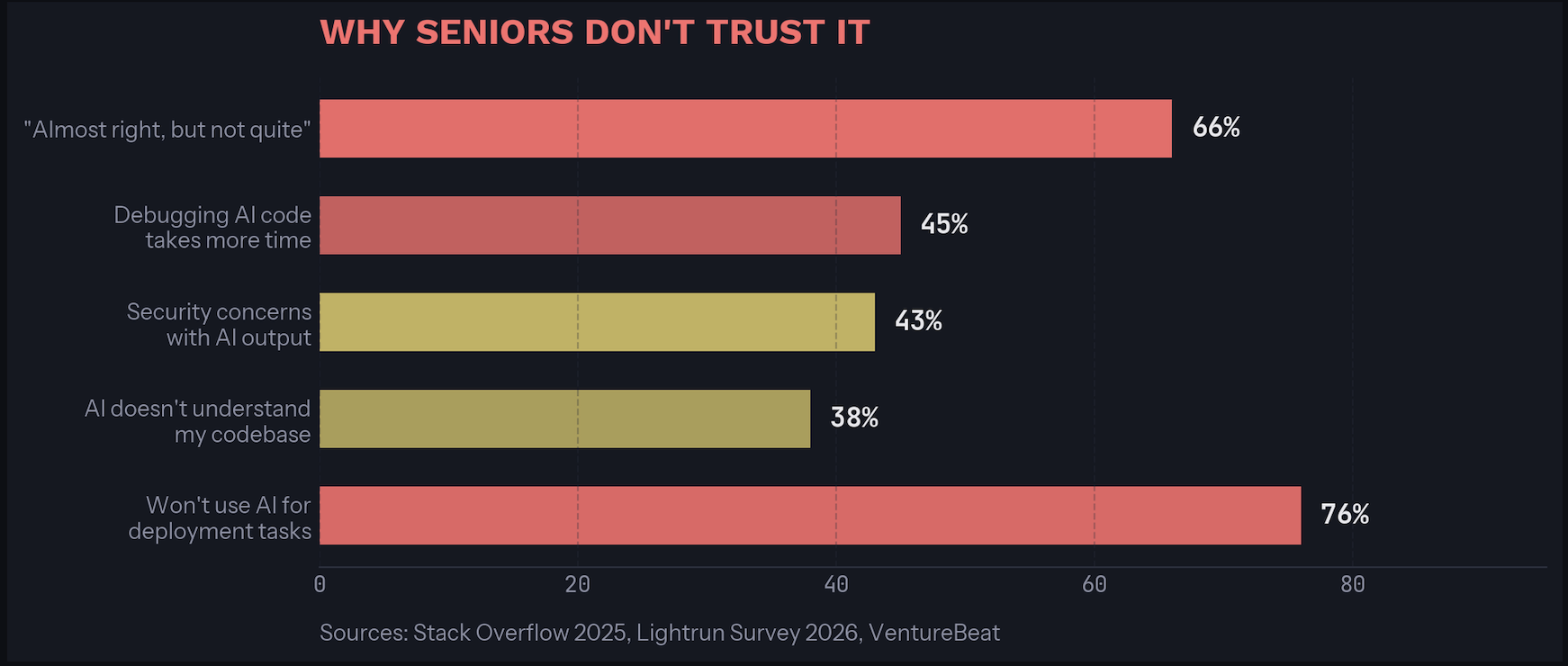
66 percent of developers say their biggest frustration is AI giving them code that's "almost right, but not quite." That sounds harmless until you realize "almost right" in code means broken. And 45 percent say debugging AI-generated code takes MORE time than just writing it yourself.
That's not a productivity tool. That's a productivity tax wearing a productivity costume.
Juniors Ship Blind. Seniors Verify Everything.
There's a massive gap between how juniors and seniors experience these tools and this is where things get real.
Junior developers under 2 years experience — 60.2 percent of them would ship AI-generated code to production without reviewing it. Sixty percent. Just tab-tab-tab-push.
Senior developers with 10 plus years? Only 25.8 percent would do the same. And here's the kicker — seniors actually report HIGHER quality improvements from AI tools. 68.2 percent compared to 51.9 percent for juniors. They get more out of it. They just know enough to check everything.
The METR randomized trial found that experienced open-source maintainers were 19 percent SLOWER when using AI tools. Not faster. Slower. Because the time they spent verifying, fixing edge cases, and undoing the subtle mistakes ate up all the speed gains.
The distrust isn't irrational. Experienced devs have seen what happens when untested code hits production at 2am on a Friday. They've debugged race conditions that only show up under load. They know that code that "looks right" and code that "is right" are two very different things.
76 percent of developers won't use AI for deployment tasks. That tells you everything about where the trust boundary actually sits.
Your Codebase Is Rotting and You Don't Even Know It
This is the part that should scare people but doesn't get enough attention.
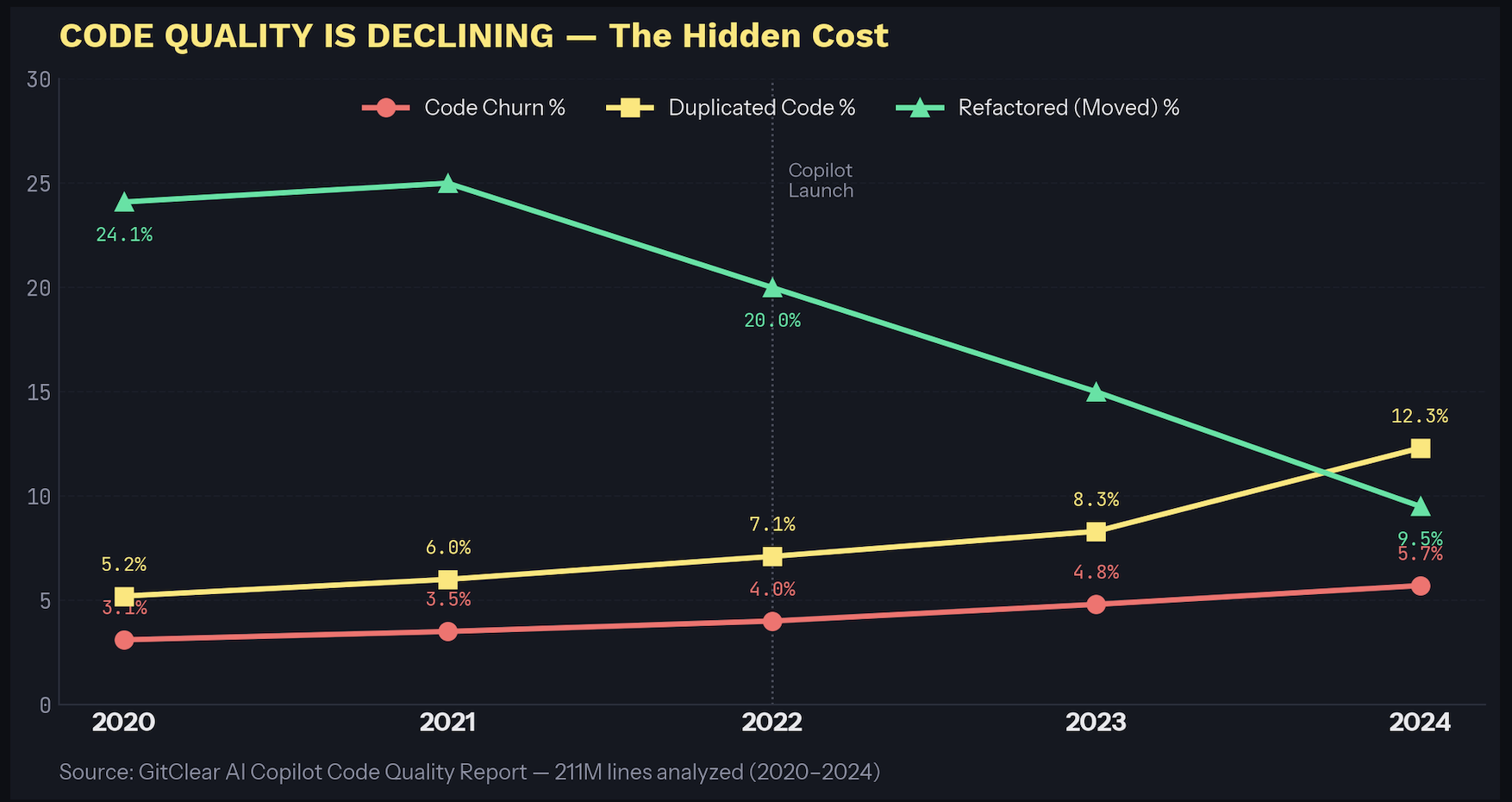
GitClear analyzed 211 million lines of code across Google, Microsoft, Meta, and enterprise repos from 2020 to 2024. The findings are rough.
Code churn — code that gets rewritten or deleted within two weeks of being committed — went from 3.1 percent in 2020 to 5.7 percent in 2024. Nearly doubled since AI tools went mainstream.
Code duplication exploded. Copy-paste code went from 8.3 percent to 12.3 percent. A 4x increase in duplicate code blocks.
And refactoring — the thing that keeps codebases clean and maintainable — collapsed from 24.1 percent of all code changes down to just 9.5 percent.
For the first time in the history of software development, developers are copy-pasting more code than they are refactoring. Let that sink in.
A Lightrun survey found that 43 percent of AI-generated code changes need debugging in production. Not in testing. In production. Google's DORA 2025 report confirmed the pattern — AI adoption correlates with higher throughput but lower delivery stability.
The vibe coders won't feel this pain today. They'll feel it in six months when their codebase is a tangled mess of duplicated logic, inconsistent patterns, and technical debt that no AI can untangle — because the AI is the one that created it.
I Used Claude Code for a Week. Here's What Actually Happened.
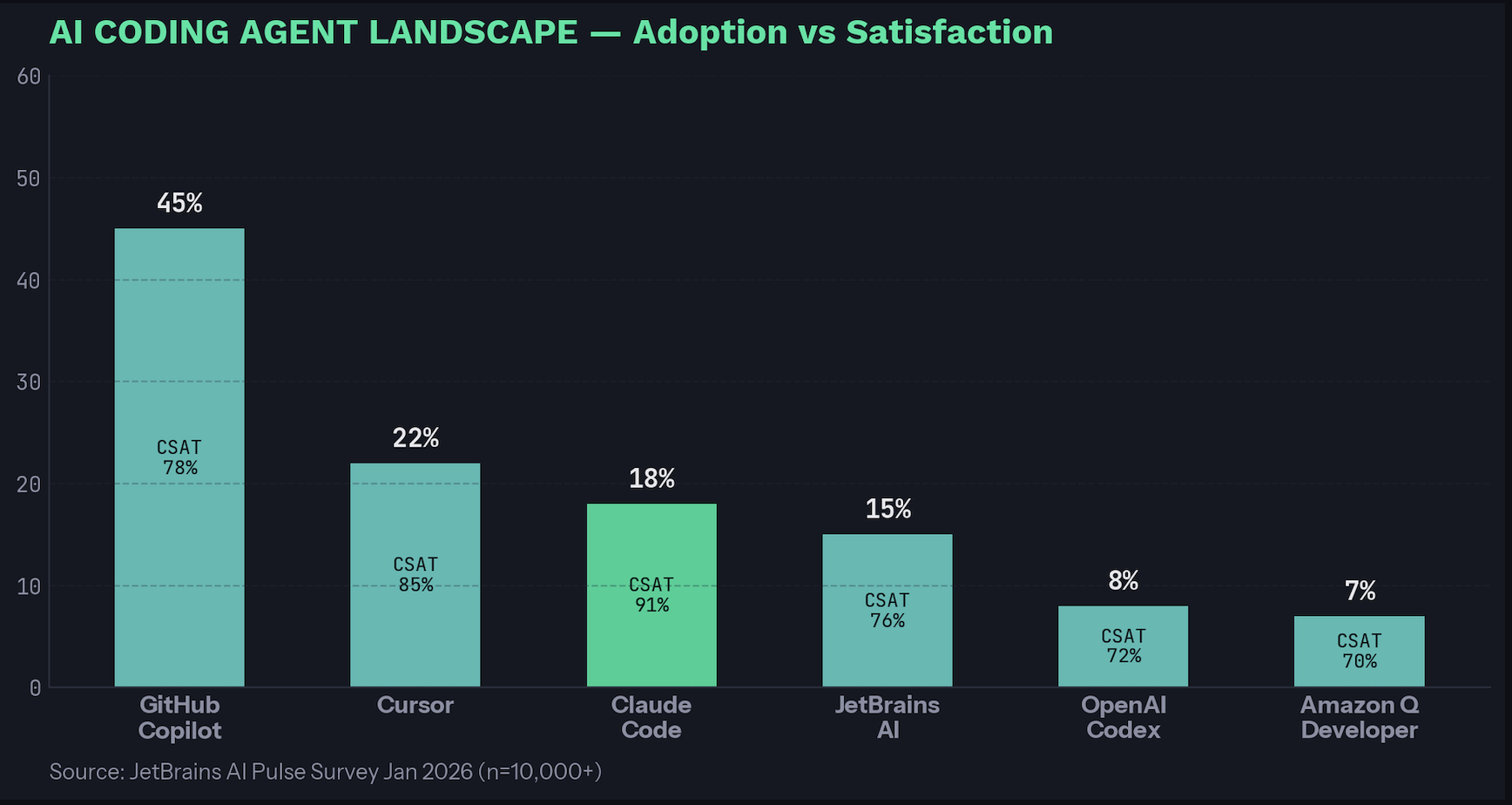
I was building a platform. Not a toy project. A real build with authentication, data pipelines, API integrations, the whole thing.
Where it genuinely helped
The repeated stuff. Boilerplate. Setting up CRUD endpoints. Generating test scaffolds. Writing migration files. All the mechanical tasks that eat your hours but don't need creative thinking — Claude Code ripped through those. My development speed went up noticeably. The ramp from "I know what I want to build" to "the basic structure exists" was significantly faster.
When I already had the architecture in my head and just needed someone to type it out quickly and correctly — it worked. It was like having a fast junior dev who never gets tired and doesn't need coffee breaks.
Where it completely fell apart
It doesn't understand your system. It doesn't know why you structured the database that way. It doesn't know your business logic edge cases. It doesn't know that this particular API endpoint gets hammered at month-end and needs to be optimized differently. It generates plausible code — not correct code.
And "plausible" is dangerous. Because it looks right. It passes a quick glance. It might even pass basic tests. But when real traffic hits, when edge cases show up, when that one customer does that one weird thing they always do — that's when plausible falls apart.
What I actually learned from the experience
Claude Code didn't replace my knowledge. It amplified it. The one who already knows about system development process leverages it. The one who just discovered it and tries to vibe code with it — builds something that looks finished but isn't.
The imperfections AI introduces are invisible to someone who doesn't know what correct looks like. You'll ship something that works in the demo and breaks in the real world. And you won't even know why.
It's a Power Tool, Not a Magic Wand
The people who get the most out of coding agents are the ones who already know how to build systems. If you understand the development process, the architecture patterns, the deployment constraints — you can leverage these tools as a force multiplier. You spot the mistakes. You know when the suggested approach won't scale. You keep the quality bar where it needs to be.
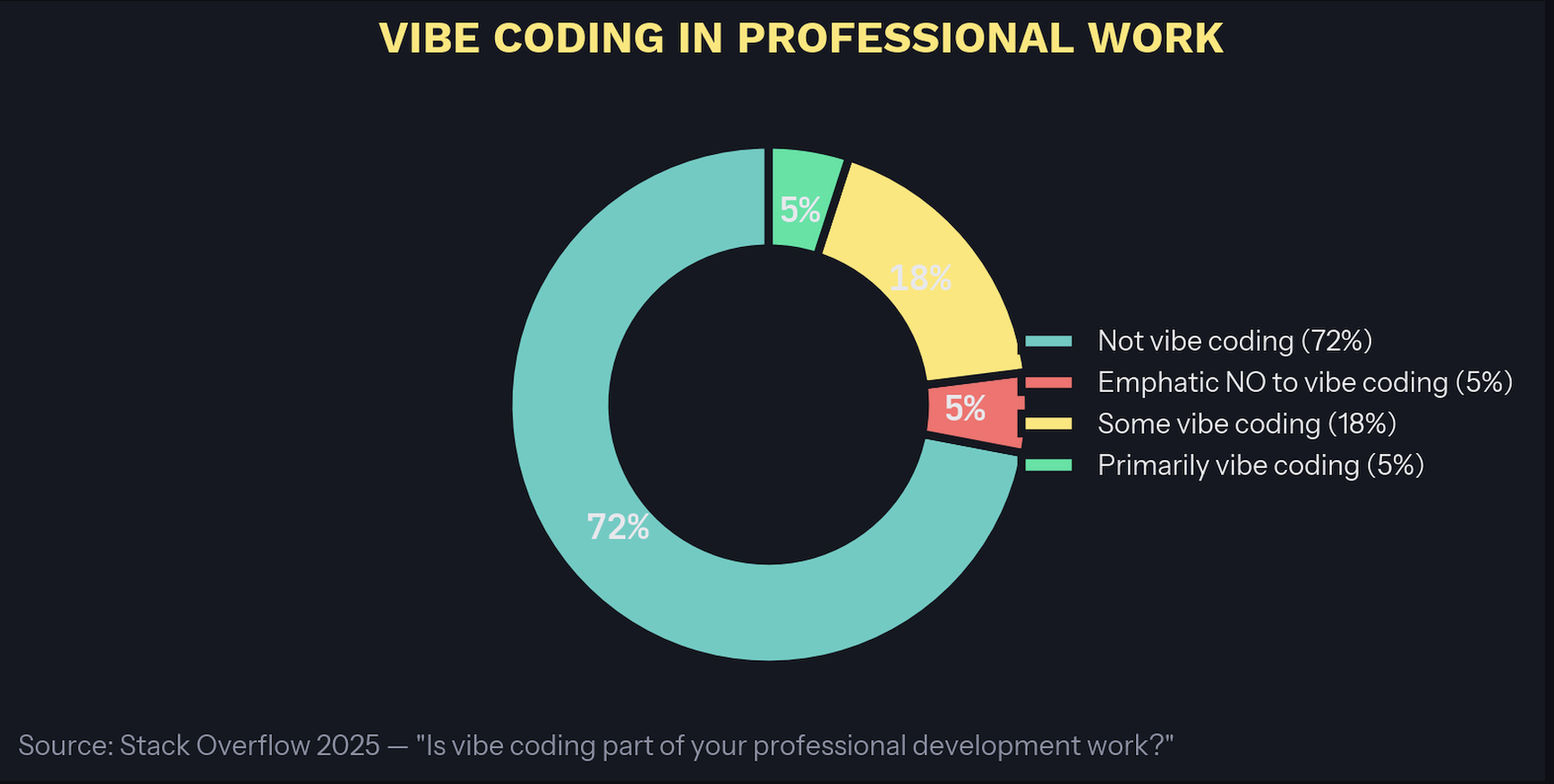
77 percent of professional developers say vibe coding is not part of their workflow. Only 5 percent primarily vibe code professionally. The Stack Overflow survey literally had to add an emphatic "NO" option because developers felt that strongly about it.
The agents are real. The productivity gains are real — for the right people. But the idea that anyone can skip the hard part of learning how software actually works and just prompt their way to a production system is not real. And the data proves it.
Coding agents aren't replacing developers. They're separating the ones who actually understand what they're building from the ones who were always just copying and pasting anyway.
References
Stack Overflow Developer Survey 2025 https://survey.stackoverflow.co/2025/
Stack Overflow 2025 AI Section https://survey.stackoverflow.co/2025/ai
JetBrains State of Developer Ecosystem 2025 https://blog.jetbrains.com/research/2025/10/state-of-developer-ecosystem-2025/
JetBrains AI Pulse Survey January 2026 — AI Coding Tools Adoption https://blog.jetbrains.com/research/2026/04/which-ai-coding-tools-do-developers-actually-use-at-work/
GitClear AI Copilot Code Quality Research 2025 — 211 Million Lines Analyzed https://www.gitclear.com/ai_assistant_code_quality_2025_research
SonarSource State of Code Developer Survey Report 2026 https://www.sonarsource.com/state-of-code-developer-survey-report.pdf
VentureBeat — 43 Percent of AI-Generated Code Changes Need Debugging in Production https://venturebeat.com/technology/43-of-ai-generated-code-changes-need-debugging-in-production-survey-finds
METR Randomized Trial — Experienced Developers 19 Percent Slower With AI https://arxiv.org/pdf/2512.14012
UC San Diego — Professional Software Developers Don't Vibe, They Control https://arxiv.org/pdf/2512.14012
Enjoyed this article? Share it: