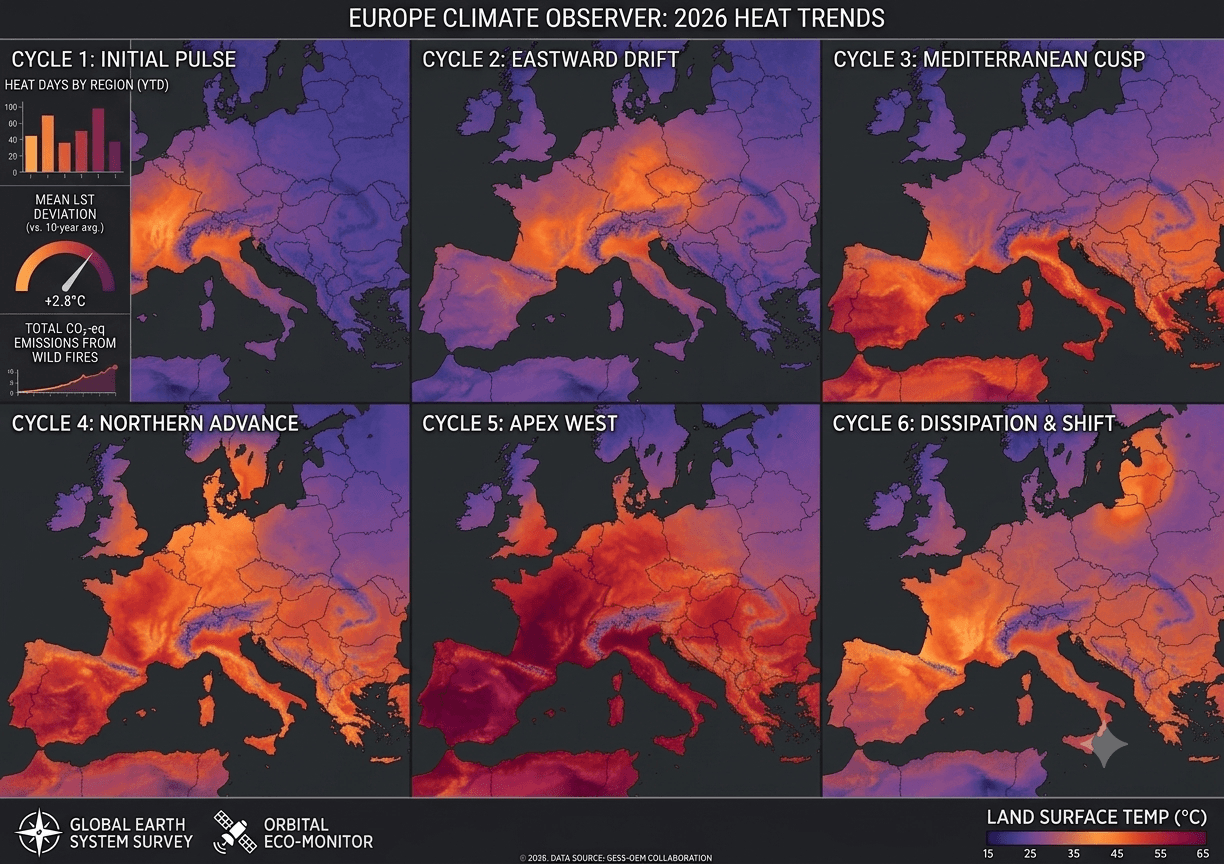
Introduction: Europe Is Entering a New Climate Regime
Over the past two decades, Europe has shifted from a region occasionally affected by extreme heat to one where heatwaves are now a regular, intensifying feature of summer climate conditions.
According to the European Environment Agency (EEA) and Copernicus Climate Change Service, Europe is warming at approximately twice the global average rate. This amplification is due to a combination of land-dominated geography, Arctic amplification effects, and atmospheric circulation changes.
Recent summers have repeatedly broken historical records:
2022: One of the hottest summers in European recorded history
2023: Record-breaking marine heatwaves and extreme continental heat
2024–2025: Continued exceedance of long-term temperature averages in multiple regions
Heatwaves are no longer isolated anomalies. They are emerging as part of a structural shift in the European climate system.
1. The Fundamental Driver: Anthropogenic Greenhouse Gas Accumulation
1.1 Radiative forcing and global temperature rise
The foundation of all observed heatwave intensification is the increase in atmospheric greenhouse gas concentrations.
According to the IPCC Sixth Assessment Report (AR6):
Global mean surface temperature has increased by approximately 1.1–1.3°C since pre-industrial levels
CO₂ concentration has exceeded 420 ppm, the highest in at least 2 million years
Methane levels are more than 2.5 times pre-industrial concentrations
This creates a persistent radiative imbalance of approximately +2.7 W/m², meaning more energy enters the Earth system than leaves it.
1.2 Why Europe responds more strongly
Europe is not warming uniformly. Several physical mechanisms amplify heat:
(a) Land–ocean contrast
Land surfaces heat faster than oceans due to lower heat capacity. Europe’s large continental interior (Germany, France, Central Europe) therefore warms faster than global averages.
(b) Arctic amplification feedback
The Arctic is warming roughly 3–4 times faster than the global average. This reduces the equator-to-pole temperature gradient, which weakens the jet stream and increases atmospheric blocking.
(c) Soil moisture depletion feedback
Dry soils reduce evaporative cooling, increasing surface temperature extremes. This mechanism is now considered one of the strongest local amplifiers of European heatwaves (Seneviratne et al., Nature Climate Change).
2. Atmospheric Dynamics: Why Heatwaves Persist Over Europe
Even with global warming as a baseline, extreme heat events are strongly shaped by atmospheric circulation.
2.1 Blocking high-pressure systems
European heatwaves are often associated with persistent high-pressure systems, known as “blocking events.”
Characteristics include:
Stable descending air suppressing cloud formation
Reduced wind circulation
Persistent clear-sky conditions increasing solar radiation
Studies show that blocking frequency has increased in parts of Europe, although regional variability remains significant.
2.2 Jet stream weakening hypothesis
The jet stream is driven by temperature gradients between the Arctic and mid-latitudes. As the Arctic warms faster:
The gradient weakens
Jet stream flow becomes more wavy
Weather systems slow down and stall
This increases the probability of prolonged heatwaves, droughts, and floods.
While this mechanism is still under active research debate, observational data increasingly supports increased persistence of extreme weather patterns.
3. Land Surface Feedbacks: The Soil Moisture–Heatwave Amplifier
One of the most important but underappreciated drivers of European heatwaves is soil moisture depletion.
3.1 Energy partition shift
Under normal conditions:
Solar energy is divided into sensible heat + latent heat (evaporation)
When soil dries:
Latent heat flux decreases
More energy becomes sensible heat
Air temperature rises faster
3.2 Quantified impact
Research published in Nature Climate Change (Seneviratne et al.) shows:
Soil moisture deficits can increase heatwave intensity by 2–5°C locally
Dry soil conditions significantly increase the probability of compound heat extremes
3.3 Southern and Central Europe vulnerability
Mediterranean Europe is particularly affected due to:
Seasonal precipitation decline in summer
High evapotranspiration rates
Agricultural water stress
This feedback loop is now considered a key driver of “flash heatwaves” in Europe.
4. Wildfires: A Growing Climate Feedback Mechanism
Wildfires are increasingly part of the climate system rather than separate events.
4.1 Carbon emissions from fires
According to the Copernicus Atmosphere Monitoring Service (CAMS):
Global wildfire emissions vary widely but can reach several gigatonnes of CO₂ annually in extreme years
The 2023 Canadian wildfires alone emitted approximately hundreds of megatonnes of CO₂, exceeding many national annual emissions
4.2 Climate feedback loop
Wildfires contribute to warming through:
(a) Immediate emissions
Carbon stored in vegetation is released rapidly into the atmosphere.
(b) Loss of carbon sinks
Burned ecosystems reduce future CO₂ absorption capacity for decades.
(c) Albedo and land surface changes
Burned landscapes absorb more solar energy, increasing local heating.
4.3 Europe-specific impact
Southern Europe (Portugal, Spain, Italy, Greece) is experiencing:
Longer fire seasons
Higher burned area variability
Increased wildfire–heatwave compounding events
These events reinforce each other: heat increases fire risk, and fires increase heat.
5. Do Wars Contribute to Climate Change? A Balanced Scientific Assessment
This is a complex and often misunderstood area. The key distinction is between primary drivers and secondary contributors.
5.1 Military emissions (direct impact)
Military activity includes:
Aircraft fuel combustion
Armored vehicle logistics
Naval operations
Supply chain transport systems
Estimates from academic and NGO studies suggest military emissions account for roughly 1–5% of global greenhouse gas emissions, although precise figures are uncertain due to incomplete reporting.
5.2 Conflict-related destruction emissions
Wars generate emissions through:
Destruction of infrastructure
Burning of cities and industrial facilities
Post-conflict reconstruction (cement, steel production)
Cement alone contributes approximately 7–8% of global CO₂ emissions, making reconstruction highly emissions-intensive.
5.3 Land-use disruption and ecosystem loss
Conflict zones often experience:
Deforestation due to fuel scarcity
Abandonment of land management
Agricultural system collapse
Wetland and soil degradation
These reduce regional carbon sequestration capacity.
5.4 Indirect global effects
Conflicts can indirectly affect climate trajectories through:
Energy market disruptions (e.g., Europe’s shift to LNG after 2022)
Delayed fossil fuel phase-out decisions
Increased global military spending, which itself is carbon-intensive
A 2025 study in Nature Communications found correlations between military expenditure increases and rising emissions intensity in economies under security stress.
Important Scientific Clarification
While conflicts do have measurable climate impacts, they are not considered a primary driver of global warming compared to fossil fuel combustion, which remains responsible for the vast majority of emissions.
The scientific consensus places wars in the category of:
Secondary but structurally relevant contributors that can amplify or delay mitigation pathways.
6. Why Heatwaves in Europe Are Becoming More Dangerous
Heatwaves today are more deadly not only because temperatures are higher, but because exposure and vulnerability have increased.
6.1 Urban heat island effect
Urban environments retain heat due to:
Concrete and asphalt surfaces
Limited vegetation
Waste heat from transport and industry
Nighttime cooling is especially reduced, increasing health risks.
6.2 Demographic exposure
Europe has one of the oldest populations globally. Heat-related mortality increases significantly with age due to reduced thermoregulation capacity.
6.3 Infrastructure mismatch
Many European buildings were designed for cold climates, not sustained heat above 35–40°C.
6.4 Compounding heat events
Modern heatwaves often occur:
Earlier in the season
More frequently in sequence
With shorter recovery intervals
This reduces resilience across populations and ecosystems.
7. Outlook Toward 2030: Scientific Projections
Based on IPCC AR6, WMO projections, and Copernicus data:
7.1 Temperature trajectory
High probability of at least temporary exceedance of 1.5°C global warming threshold before 2030
Europe likely to experience 2–3°C above pre-industrial conditions regionally during extreme summers
7.2 Heatwave frequency
Increase in heatwave days across Central and Northern Europe
Expansion of Mediterranean-type heat conditions northward
7.3 Mortality risk
European Environment Agency projections indicate:
Significant increase in heat-related mortality without adaptation
Risk escalation especially in urban populations
7.4 Wildfire and drought risk
Higher probability of extreme fire seasons
Increased drought frequency in Southern Europe
Growing risk of compound heat–fire–water stress events
Conclusion: A System Under Multiple Pressures
Europe’s heatwaves are not caused by a single factor but by a layered system of interacting processes:
Long-term greenhouse gas accumulation (primary driver)
Atmospheric circulation changes (heat persistence)
Soil moisture and land feedback loops (local amplification)
Wildfire carbon and ecosystem loss (feedback acceleration)
Indirect geopolitical and energy system disruptions (structural influence)
Among these, climate change remains the dominant force. However, the intensity and variability of heatwaves are shaped by how these systems interact.
Europe is therefore not only warming. It is entering a new climate regime in which extreme heat becomes a defining feature of summer conditions rather than an exception.
The central challenge of the next decade is not only reducing emissions, but also adapting infrastructure, cities, and public health systems to a climate reality that is already locked in.
References (Selected Scientific Sources)
IPCC Sixth Assessment Report (AR6), 2021–2023
European Environment Agency (EEA) Climate Reports
Copernicus Climate Change Service (C3S) Annual Reports
World Meteorological Organization (WMO) Global Climate Updates
Seneviratne et al., Nature Climate Change (Soil moisture–temperature feedbacks)
Nature Communications (2025), Military expenditure and emissions intensity study
CAMS (Copernicus Atmosphere Monitoring Service) Wildfire Emissions Reports
European Commission Joint Research Centre climate impact assessments
Enjoyed this article? Share it: